“Discover the Difference Between Sublimation and Transfer Papers!” – SUBLIMATIONTRANSFERPAPER – Hi-Sticky Sublimation Heat Paper Wholesale, A4 Inkjet Sublimation Paper Supplier, Made in China
In the field of digital printing, sublimation paper and transfer paper are two commonly mentioned materials, and many people often confuse them with each other. However, despite their similar appearance and the shared goal of transferring patterns to substrates, they are not the same thing. This article will elaborate on the differences between sublimation paper and transfer paper from multiple aspects, so as to clarify the misunderstanding that they are identical.
1. Fundamental Differences in Working Principles
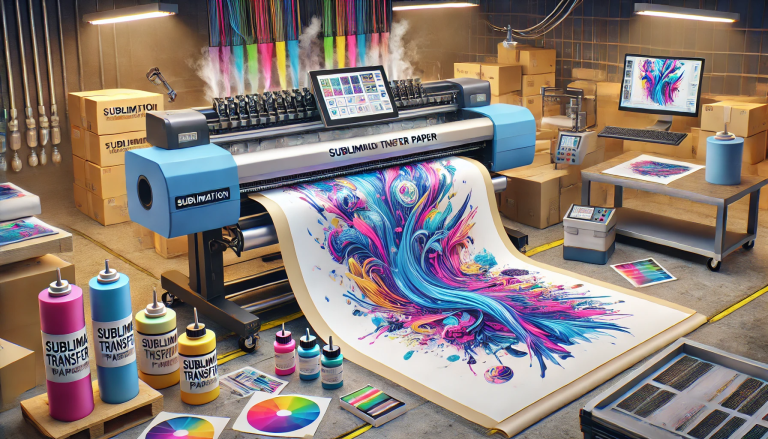
Firstly, the core working principles of sublimation paper and transfer paper are fundamentally different. Sublimation paper relies on the sublimation phenomenon of special dyes. When heated to a certain temperature, the sublimation dye on the paper will directly change from a solid state to a gaseous state, penetrate into the interior of the substrate (usually polyester or polyester-coated materials), and then condense and fix when cooled, forming a pattern that is integrated with the substrate. In contrast, transfer paper works through the principle of adhesion. The ink or pigment on the paper is transferred to the surface of the substrate under the action of heat and pressure, and adheres to the surface to form a pattern. Unlike sublimation paper, the pattern formed by transfer paper is a layer attached to the surface of the substrate rather than penetrating into it.
Secondly, the applicable substrates and ink types of the two papers are quite different. Sublimation paper has strict requirements on substrates. It can only be used on materials with polyester components or materials coated with polyester. This is because only polyester fibers have the structure that can trap the sublimated dye molecules. If used on cotton, linen and other natural fibers without polyester coating, the pattern will be easy to fade and fall off. The ink matched with sublimation paper is also special sublimation ink. On the other hand, transfer paper has a wider range of applicable substrates, including cotton, linen, silk, synthetic fibers, ceramics, metals and other materials. According to different substrates, transfer paper can be divided into thermal transfer paper for textiles, ceramic transfer paper and so on. The inks used with transfer paper are also more diverse, such as pigment ink, dye ink, etc., depending on the type of transfer paper and the substrate.
2. Variations in Applicable Substrates and Ink Types
Secondly, the applicable substrates and ink types of the two papers are quite different. Sublimation paper has strict requirements on substrates. It can only be used on materials with polyester components or materials coated with polyester. This is because only polyester fibers have the structure that can trap the sublimated dye molecules. If used on cotton, linen and other natural fibers without polyester coating, the pattern will be easy to fade and fall off. The ink matched with sublimation paper is also special sublimation ink. On the other hand, transfer paper has a wider range of applicable substrates, including cotton, linen, silk, synthetic fibers, ceramics, metals and other materials. According to different substrates, transfer paper can be divided into thermal transfer paper for textiles, ceramic transfer paper and so on. The inks used with transfer paper are also more diverse, such as pigment ink, dye ink, etc., depending on the type of transfer paper and the substrate.
3. Differences in Pattern Effects and Durability
In addition, there are obvious differences in the effect and durability of the patterns formed by the two papers. The pattern transferred by sublimation paper has the advantages of bright colors, good air permeability and strong durability. Since the dye penetrates into the substrate, the pattern will not peel off, crack or fade even after repeated washing and friction, and it also has good hand feel, which is almost the same as the original substrate. In contrast, the pattern transferred by transfer paper is relatively easy to have problems such as fading, peeling and cracking after long-term use or repeated washing. Especially for textile substrates, the hand feel of the pattern part may be slightly hard, affecting the comfort of wearing. However, transfer paper also has its own advantages, such as simple operation, low equipment requirements and low cost, which makes it widely used in small-batch customization and personal hobbies.
4. Distinct Application Fields
It should also be noted that the application fields of sublimation paper and transfer paper are also different due to the above differences. Sublimation paper is widely used in the production of sportswear, swimwear, flags, banners, digital photo albums and other products that require high color fastness and air permeability. Transfer paper is more suitable for personalized customization of T-shirts, cultural shirts, ceramic mugs, key chains and other daily necessities, as well as small-batch production of various promotional products.
5. Conclusion
To sum up, sublimation paper and transfer paper are not the same. They differ in working principle, applicable substrates, matched inks, pattern effects and application fields. Understanding these differences is crucial for choosing the appropriate printing materials in practical applications. Whether it is industrial mass production or personal DIY, only by selecting the right paper according to the specific needs can the ideal printing effect be achieved.